Locked In, Blinded, and Told to Clap: What the New Israel Package Reveals About Congress and MAGA
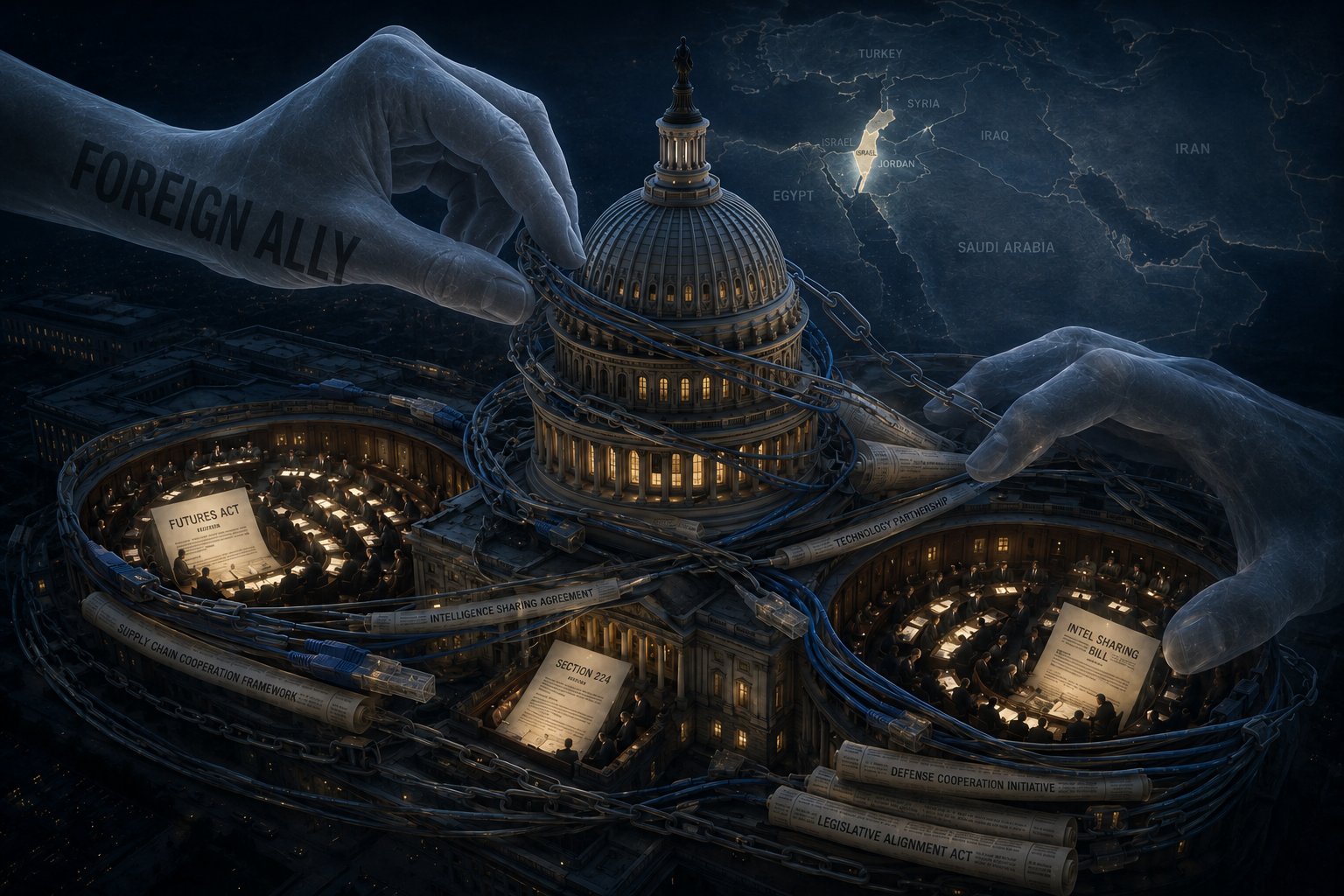
Image Generated via Chat GPT.com
If future generations want a clear example of how a great power’s political class can let fear, ideology, and loyalty to a single man cloud its judgment, they won’t have to look far. The record Congress and much of the MAGA movement are creating right now around Israel and the Iran war will do nicely.
While most of the country is focused on Gaza and the war with Iran, lawmakers in both chambers are advancing a coordinated package of measures that will structurally tie America’s military, technology base, and intelligence flows more tightly to Israel. They’re doing this at the exact moment our own intelligence agencies are warning that Israel is a top‑tier espionage threat and the world is recoiling from Israel’s conduct in Gaza and the West Bank. At the same time, much of the self‑described “America First” base is being told to treat questioning any of this as disloyalty to Trump or betrayal of the team.
The problem isn’t that there’s no strategic logic at all. The problem is that these laws aggressively pursue one side of the logic, short‑term cooperation and access to Israeli innovation, while almost completely ignoring the obvious sovereignty risks. And the political culture around them punishes anyone who tries to point that out.
The package: tech, weapons, and intelligence
The first pillar is the United States–Israel FUTURES Act. This bill establishes a “Defense Technology Cooperation Initiative” that directs the Pentagon to work with Israel across a long list of sensitive fields: artificial intelligence, autonomous systems, cyber defense, missile and air defense, counter‑drone capabilities, directed energy, biotechnology, biomanufacturing, and more. It authorizes 150 million dollars per year from 2027 to 2029 to identify Israeli‑origin and jointly developed technologies and integrate them into U.S. defense programs. The explicit goal is to move beyond simple aid and embed Israeli and joint technologies in the core systems the U.S. military uses.
The second pillar is Section 224 of the House’s Fiscal Year 2027 National Defense Authorization Act. This provision takes the FUTURES concept and implements it. It tells the Secretary of Defense to appoint an executive agent to coordinate U.S.–Israel defense tech cooperation and to identify Israeli and joint technologies suitable for integration into “programs of record,” meaning the formal, fully funded, long‑term acquisition programs for weapons and information systems. Once something’s in a program of record, it’s no longer experimental. It becomes part of the standard gear U.S. forces are built around.
The third pillar is Section 622 of the Senate’s Intelligence Authorization Act, introduced by Senator Tom Cotton. This section, titled “United States–Israel Intelligence Sharing Enhancement,” instructs the president to “expand and enhance” intelligence sharing with Israel on a broad range of topics across the Middle East. It then says that this sharing “shall not be suspended, reduced, or otherwise materially limited” unless the president identifies a specific national security concern and, within 15 days, submits a detailed report to Congress explaining what’s being cut and why.
Put together, these three measures push U.S.–Israel co‑development in some of the most sensitive technology domains into a long‑term framework with dedicated funding, drive Israeli and joint technologies into the official weapon and IT programs the U.S. military will use for years, and make expansive intelligence sharing with Israel the legal default while raising the bar for any future president who wants to dial it back.
If you wanted to design statutes that take a partner from “ally” toward “quasi‑integrated component of your security apparatus,” you’d write something very much like this.

From a sovereignty perspective, this package creates several distinct problems.
The sovereignty risks, spelled out…
Structural dependence
When you deliberately integrate Israeli‑origin and joint technologies into your long‑term weapons and IT programs, you’re building foreign components and know‑how into the backbone of your military. If Israel later withholds a component, delays an update, or changes licensing terms, it can affect U.S. readiness and narrow America’s room to maneuver.
A recent pair of examples shows why this kind of dependence is so dangerous. During the Covid pandemic, the United States discovered how vulnerable it was after decades of offshoring large portions of its medical supply chain to China and a handful of other low‑cost producers. When global demand spiked and Beijing prioritized its own population and favored partners, Americans suddenly faced shortages of basic protective gear, key drug ingredients, and medical devices, because critical production capacity sat outside U.S. control. Washington hadn’t formally surrendered sovereignty, but in practice it couldn’t simply decide what to do; it had to live with the constraints imposed by past choices that made it structurally dependent on a rival’s factories.
The same basic problem shows up in the world’s dependence on Taiwan’s semiconductor industry. A single company in a geopolitically fragile location now produces a huge share of the world’s most advanced chips, including those used in U.S. military and critical infrastructure systems. That concentration gives events in the Taiwan Strait outsized leverage over American economic and security choices. It’s not that the U.S. signed away its sovereignty on paper; it’s that we allowed a foreign node to become so indispensable that any disruption there forces our hand.
Building Israeli components and know‑how into America’s core military systems risks repeating those mistakes in an even more sensitive domain. If a future crisis puts U.S. and Israeli interests sharply at odds, an America that has tied its “standard issue” weapons and networks to Israeli inputs will find its freedom of action limited not just by politics, but by its own wiring.
Foreign priorities inside U.S. planning
These laws don’t just buy technology. They direct the Pentagon to seek out and integrate Israeli and joint solutions in high‑priority fields. Over time, that means Israeli threat perceptions and Israeli regional priorities can become embedded in U.S. capability development, especially around Iran, missile defense, drones, and regional surveillance architecture.
It’s also important to be honest about the “shared values” claim that’s often used to justify this kind of integration. On paper, both countries describe themselves as democracies with commitments to individual rights and the rule of law. In practice, recent Israeli behavior in Gaza and the West Bank, the mass civilian casualties, systematic destruction of civilian infrastructure, long‑term blockade, and open defiance of UN resolutions and International Court of Justice orders points to a governing ethic that diverges sharply from the values the United States says it stands for. U.S. public opinion reflects that unease: majorities now view Israel unfavorably, and large shares describe its actions in Gaza as genocide.
When you build Israeli systems and joint pipelines into U.S. planning, you’re not just importing neutral technology; you’re importing tools shaped by a very particular set of political and moral priorities. Embedding those tools upstream in our own planning increases the risk that Israel’s values and preferences – including a willingness to accept far higher civilian costs and regional escalation than most Americans support – will be reflected in U.S. options and default responses. That’s not just a technical issue. It’s a values issue, and it complicates any claim that deeper integration is automatically safe because “we share the same ideals.”
Narrowing presidential discretion
Cotton’s Section 622 creates a special rule for one country: intelligence sharing with Israel cannot be significantly reduced without a specific finding and a report to Congress. That doesn’t eliminate presidential discretion, but it raises the legal and political cost of using it, and it does so for one foreign state in a way that is not standard for other allies.
This new one‑country carve‑out is especially striking when you remember how many of the same lawmakers and commentators treated presidential freedom of action as sacrosanct when Trump ordered the 2020 drone strike that killed Qassem Soleimani. At that time, the pro‑administration argument leaned hard on the president’s inherent Article II authority to use force abroad without advance congressional authorization, so long as the action was framed as a limited act of self‑defense rather than a full‑scale war. The message was clear: do not tie the president’s hands when American lives and interests are at stake, especially in fast‑moving situations with Iran.
Now, when the question is whether future presidents should be free to scale back intelligence sharing or technical integration with Israel if circumstances change, many of those same voices are endorsing statutory language that does exactly what they once warned against: it ties the hands of future presidents, but in one direction only. A president who wants to escalate with Iran can still cite inherent authority and “imminent threats.” A president who wants to reduce certain flows of information or technology to Israel, however, will have to clear a higher legal and political bar than for almost any other ally. The principle, in other words, isn’t “protect the office’s flexibility.” It’s “protect this particular foreign relationship,” even at the cost of limiting future American leaders’ options.
More access for a “critical” espionage threat
DIA’s “critical” counterintelligence designation means the U.S. government is already warning that Israel is unusually aggressive in spying on U.S. officials and institutions. In that context, expanding intelligence and tech sharing with Israel increases the risk of unauthorized collection, deeper visibility into U.S. systems, and more opportunities for a foreign state to learn how America thinks and where it is vulnerable.
Making future course corrections harder
Once Israeli tech is embedded in U.S. systems and intelligence sharing is statutorily favored, any future president or Congress that wants to pull back will face operational disruption, political blowback, and pressure from contractors and allies. That is the whole point of “future‑proofing” the relationship: make the price of saying “enough” high enough that few leaders will want to pay it.
Espionage warnings and a collapsing moral partner
The reality now looks very different from the sales pitch in these bills.
The Pentagon’s Defense Intelligence Agency has quietly raised Israel’s counterintelligence threat rating to “critical,” its highest level, amid concern that Israeli services are aggressively targeting U.S. officials and internal deliberations to glean what Washington is really deciding about Gaza, Lebanon, and the war with Iran. At the same time, Israel’s behavior in Gaza, the West Bank, and Lebanon has driven its global standing into the ground: across 36 countries, a median of 67 percent of adults now view Israel unfavorably and just 25 percent favorably, and U.S. views have turned mostly negative as well.
That collapse has reached the very top of U.S. politics. In a now‑infamous expletive‑laden call, Trump reportedly “steamrolled” Netanyahu over Israel’s Lebanon escalation, yelling “you’re f***ing crazy” and warning that “everybody hates you now, everybody hates Israel because of this” before urging him to back off; Trump has since confirmed that he called Netanyahu “crazy” and was “perturbed” by Israel’s conduct. Put bluntly, even Israel’s closest patron in the White House is now telling Netanyahu that his choices are isolating Israel and creating blowback for the United States.
Seen together, the pieces form a clear pattern. Israel’s military decisions are widening the rift with Washington and the rest of the world, and Israel’s answer to that rift has included ramped‑up spying on U.S. policymakers to map and shape our internal fights over what to do next. The more contested U.S. support becomes, the stronger Israel’s incentive to penetrate our decision‑making—and the more integration these bills lock in, the easier it becomes for that penetration to erode American sovereignty. In that light, the question practically asks itself: why would we deepen structural dependence on a state our own intelligence agencies now label an exceptional espionage risk, and that even its best friend in Washington says has turned much of the world, and a growing number of Americans, against it?
The missing safeguards
If the goal were truly to serve American interests first, the legislative text would look different.
There’d be clear diversification requirements so no Israeli component becomes a single point of failure. There’d be conditions tied to behavior so that violations of international humanitarian law or interference in U.S. politics trigger automatic pauses. There’d be stronger counterintelligence controls in light of DIA’s “critical” threat rating. There’d be sunset clauses and mandatory reauthorization. And there’d be an insistence on keeping presidential flexibility intact instead of narrowing it for one favored partner.
None of those safeguards are present. That absence is a choice. It suggests that the people writing and backing these laws either don’t see dependence as a problem, or they see it and accept it as an acceptable price for “future‑proofing” the relationship with Israel.
Part of that mindset is fear of chaos in the Middle East. Part of it is a longstanding Zionist outlook in Washington that treats Israel as a morally and strategically indispensable pillar. And in some quarters, there’s a quieter sense of exceptionalism at play, where Jewish suffering and Jewish security are treated as morally overriding in ways that justify bending American structures around Israel’s needs.
Whatever mix of motives one prefers, it’s not a mindset that puts American sovereignty first.
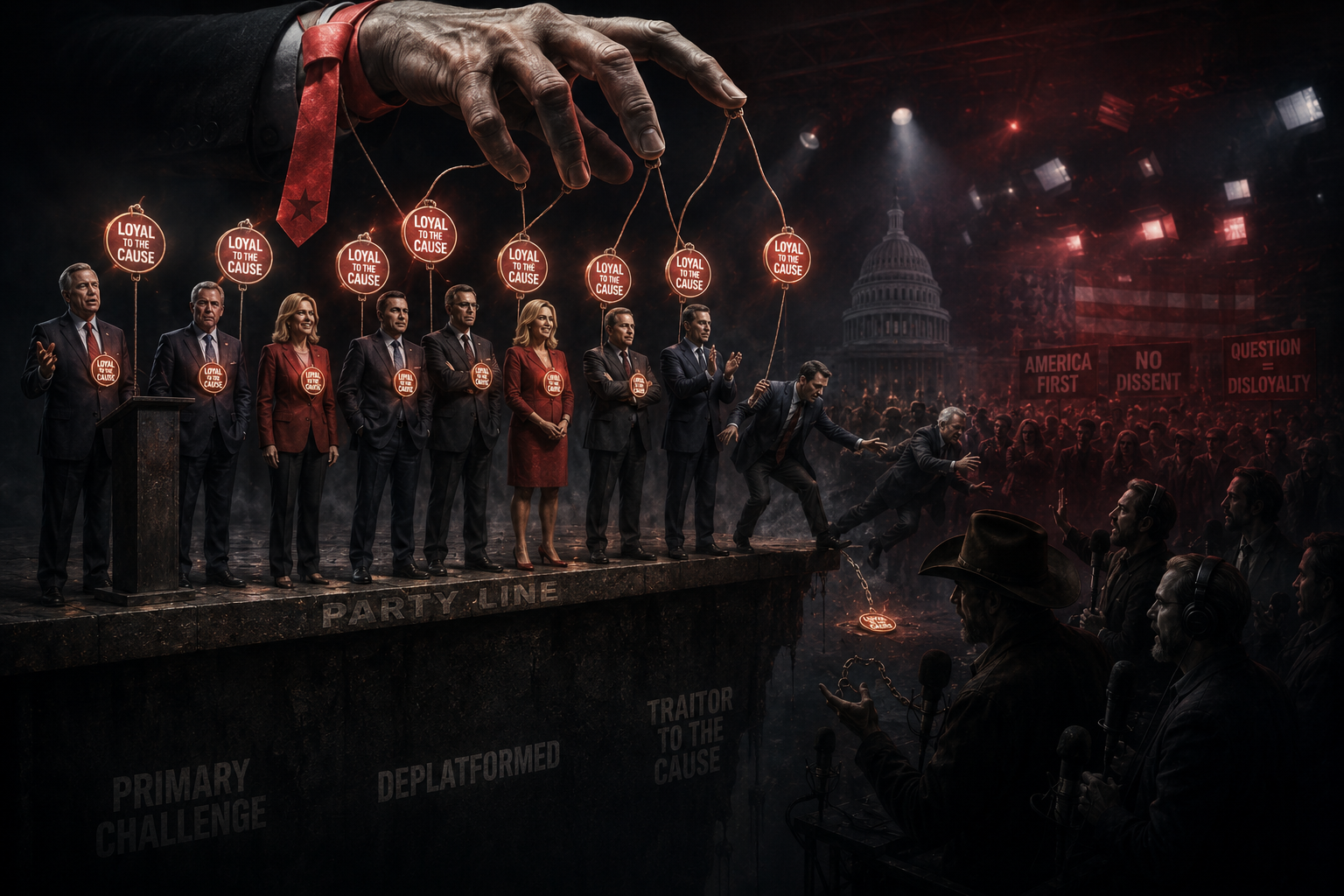
The loyalty trap inside “America First”
How rewards and reprisals keep critics in line…
The loyalty trap operates through punishment as much as praise. In Trump’s GOP, questioning the war with Iran or the deepening U.S. entanglement with Israel does not just get you ignored; it gets you marked as disloyal. Trump has publicly tried to purge Rep. Thomas Massie, endorsing a primary challenger, calling him “the worst and most unreliable Congressman in the history of our country,” and urging voters to “vote the bum out” after Massie opposed his Iran policy and criticized aspects of U.S.–Israel policy. Pro‑Israel groups then poured millions into that race, explicitly framing Massie as an enemy of Israel and helping make his primary one of the most expensive in history.
The same pattern has played out with high‑profile MAGA‑branded media figures. When Marjorie Taylor Greene began openly criticizing Trump’s foreign policy and suggesting he favored Israel’s interests over those of the United States, Trump withdrew his endorsement and dismissed her as having “lost her way,” signaling to the movement that even one of its most notorious firebrands could be cast out for crossing that line. As Trump escalated the Iran war and doubled down on support for Israel, he blasted previously loyal commentators like Candace Owens, Alex Jones, and Megyn Kelly in a Truth Social post, calling them “low IQ,” “losers,” and “nut jobs” after they objected to his approach, and insisting that they are “not MAGA.” Fundraisers tied to his orbit have also quietly dropped Owens under pressure from pro‑Israel donors, citing her record on antisemitism, underscoring how quickly dissenting voices can be frozen out when they break with the party line on Israel.
This is how the trap closes. The message to elected Republicans and conservative media alike is that loyalty to Trump now implicitly includes loyalty to a very specific set of positions on Israel and its wars—and that deviating from those positions can cost you your platform, your endorsement, or even your seat. In a system like that, it becomes much harder to have an honest debate about whether the U.S. should be binding itself even more tightly to Israel, and much easier for policies that serve another country’s priorities to pass under the banner of “America First.”

Race, narrative, and the misuse of “antisemitism”
There is only one human race…
This is where Jerome S. Bruner and Alain F. Corcos help sharpen the discussion.
Bruner’s work repeatedly emphasized that human beings don’t simply process neutral facts; they organize experience through culturally available narratives and categories. He described the human mind as both a social construct and a meaning‑making system, and he argued that what people take to be “reality” is often mediated by the stories and interpretive frameworks a culture makes available to them. That matters here because “race,” “Jewishness,” “ally,” “threat,” and even “antisemitism” are not just neutral labels. They are categories shaped by history, politics, and narrative habits.
Corcos, a biologist and geneticist, makes the biological side of the argument directly. In The Myth of the Jewish Race, he argues that antisemitism rests on false biological premises: that there are pure human races, and that Jews constitute one of them. He insists there is no biological “Jewish race,” in part because Jewish populations have never been sexually isolated and have long included intermarriage and conversion. He also notes the bitter irony that some Jews, under pressure from antisemitic categories, have at times partly internalized the same biological determinism used against them.
That insight helps explain the current confusion. The term “antisemitism” was coined by racial ideologues who wanted to dress up Jew religious and cultural hatred as a modern theory of race. Today it remains the standard word for hatred of Jews, but it is also often used to blur the line between bigotry against Jews and criticism of the Israeli state or Zionism as a political project.
Through a Bruner‑style lens, this is a narrative problem. The word does not merely describe reality; it organizes it. It can channel public attention away from actual questions of law, sovereignty, and policy and back toward a moral script in which criticism of Israel is automatically suspect. Through a Corcos‑style lens, the problem is compounded because the term carries the residue of the very race thinking it was meant to confront.
That is why a universalist position remains important. There is one human race. Hatred of Jews is real, and it is morally abhorrent, but it is best understood as a form of racism (synonymous with racism against blacks) and bigotry against Jews, not as proof that Jews constitute a separate biological race. Naming that clearly helps preserve two distinctions that matter: the distinction between opposing racism against Jews and endorsing race mythology, and the distinction between criticizing Jews as a people and criticizing the policies of the Israeli state.

What future generations may see
How today’s entanglements become tomorrow’s inheritance…
If these laws pass largely in their current form, future historians will be able to say that in the mid‑2020s, at a moment when the costs and risks of deep alignment with Israel were more visible than ever, the U.S. Congress chose to deepen that alignment, narrow the options of future leaders, and shield that choice from criticism by policing language and demanding loyalty to one man.
That’s not a story of prudence. It’s a cautionary tale. It shows how a republic can be talked, lobbied, and frightened into writing away parts of its sovereignty for the sake of a narrative about a foreign ally and American adversaries. Bruner helps explain how that narrative structure works. Corcos helps expose one of the false biological premises buried inside the language that often protects it.
An America‑first stance would look very different. It would name the sovereignty risks clearly, insist on guardrails, reject race mythology in every form, and welcome honest argument even when it cuts against the preferences of our own leaders and our own side.
Future generations will live with the institutions we normalize right now. If we continue sleepwalking—outsourcing critical infrastructure, treating loyalty to foreign governments as a party litmus test, and numbing ourselves with partisan narratives—they will inherit a United States that is formally independent but substantively constrained.
But trajectories are not prophecies. They are the accumulated result of habits: what we tolerate, what we reward, what we’re willing to say out loud when it’s unpopular.
Another hinge is whether Americans rediscover the courage to dissent without violence. A sovereign people cannot outsource its conscience to party leaders, media personalities, or donor networks and still call itself self‑governing.
That means more citizens willing to do unfashionable things: publicly oppose blank‑check security commitments, question the wisdom of embedding U.S. systems inside foreign‑controlled tech stacks, and refuse to smear neighbors as “antisemitic,” “unpatriotic,” or “authoritarian” simply for asking who really holds the levers of power. It also means defending the right of others to raise those questions, even when we disagree with their conclusions.
Tucker Carlson: War, Israel, and “America First”
BBC / interview clip – Carlson opposes Trump’s Iran war, says U.S. went to war “at the behest and then the demand of Israel,” and accuses Israel of genocide in Gaza
https://www.youtube.com/watch?v=VZBiFMuSZqsNew York Times profile – Carlson breaking with Trump over Iran, saying Israel has effectively bound Trump to its interests.
https://www.nytimes.com/2026/05/02/magazine/tucker-carlson-interview-trump-iran.htmlYouTube talk on “Did Trump betray America First?” – Carlson defends Israel’s right to exist but questions U.S. subordination of its interests to Israel’s.
https://www.youtube.com/watch?v=tox2hr4dddMShort clip blasting Israel’s Lebanon campaign and mass killing in Gaza as unjustifiable and dangerous for the U.S.
https://www.instagram.com/reel/DZcex75gZ6K/Reddit‑hosted clip from Israeli TV – Carlson says “Trump let the US be dragged into a war” and blames Netanyahu.
https://www.reddit.com/r/videos/comments/1ti94z2/tucker_carlson_on_israeli_news_channel_13/Coverage of Carlson calling Trump “complicit” in Israel’s Iran strikes and arguing the U.S. should provide “no financial aid, no American weaponry, and no troops on the ground” and should let Israel fight its own wars.
https://www.yahoo.com/news/tucker-carlson-blasts-trump-being-040325583.html
Thomas Massie and conservative anti‑interventionism
Massie statements opposing U.S. military aid to Israel and calling for an end to foreign military assistance, on principled non‑intervention grounds.
https://www.facebook.com/groups/Normanfrankelestian/posts/33656020727378453/The Nation piece noting Massie as the conservative co‑sponsor of an anti‑war resolution restricting U.S. force against Iran, alongside Sanders, etc.
https://www.thenation.com/article/politics/congress-iran-war-israel-massie/Al‑Monitor on Trump’s MAGA base defying traditional pro‑Israel doctrine, including a Heritage Foundation call to downgrade the “special relationship” to an “equal strategic partnership.”
https://www.al-monitor.com/originals/2025/07/trumps-maga-base-defies-conservative-pro-israel-doctrineAl Jazeera op‑ed on Massie’s defeat as a “pyrrhic victory” for the Israel lobby, highlighting backlash among Republicans against foreign‑aligned influence on U.S. politics.
https://www.aljazeera.com/opinions/2026/5/20/massie-defeated-the-israel-lobbys-pyrrhic-victory-in-kentucky
MAGA and conservative movement splits
NPR/NEPM piece on “MAGA is split” over U.S. involvement in the Israel–Iran conflict, documenting populist skepticism toward deeper entanglement.
https://www.nepm.org/2025-06-20/maga-is-split-over-potential-u-s-involvement-in-the-middle-eastSapir Journal essay “Saving Conservatism from Nationalism,” which, while not about Israel specifically, describes a conservative camp favoring “restrained” foreign policy and opposition to military interventions abroad
https://sapirjournal.org/fixing-america/2026/saving-conservatism-from-nationalism/
Espionage and sovereignty framing you can tie them to
NBC News – Pentagon raised threat of Israeli spying on U.S. to highest level
https://www.nbcnews.com/politics/national-security/pentagon-raised-threat-israeli-spying-us-highest-level-sources-say-rcna348565Al Jazeera explainer – notes U.S. agencies see Israel intensifying efforts to collect on U.S. talks and policy discussions.
https://www.aljazeera.com/news/2026/6/7/why-has-the-pentagon-raised-the-risk-of-israeli-spying-to-the-highest-levelDIA espionage assessment and Israel spying
NBC News – Pentagon raised threat of Israeli spying on U.S. to highest level
https://www.nbcnews.com/politics/national-security/pentagon-raised-threat-israeli-spying-us-highest-level-sources-say-rcna348565[nbcnews]Military.com – Pentagon Raises Israeli Spy Threat as NDAA Seeks Deeper Defense Ties
https://www.military.com/pentagon-raises-israeli-spy-threat-as-ndaa-seeks-deeper-defense-ties[military]Times of Israel – Pentagon raises threat assessment of Israeli spying on US to ‘critical’
https://www.timesofisrael.com/pentagon-raised-threat-assessment-of-israeli-spying-on-us-to-critical-level-report/[timesofisrael]Asharq Al-Awsat – Pentagon Raises Threat of Israeli Spying to ‘Critical’
https://english.aawsat.com/world/5281254-pentagon-raises-threat-israeli-spying-critical-according-us-media[english.aawsat]Yahoo News re‑syndication of NBC story
https://www.yahoo.com/news/politics/articles/pentagon-raised-threat-israeli-spying-021301500.html[yahoo]
Global and U.S. public opinion on Israel
Pew Research Center – Most people across 36 countries have negative views of Israel and little confidence in Netanyahu
https://www.pewresearch.org/short-reads/2026/06/04/most-people-across-36-countries-have-negative-views-of-israel-and-little-confidence-in-netanyahu/[pewresearch]Responsible Statecraft summary of Pew poll – Negative vibes for Israel in 36 countries
https://responsiblestatecraft.org/polling-israel-public-opinion/[responsiblestatecraft]Middle East Eye – Negative views of Israel soar across 36 countries since Iran war
https://www.middleeasteye.net/news/negative-views-israel-soar-across-36-countries-iran-war-survey-finds[middleeasteye]Anadolu Agency – Most people in 36 countries hold unfavorable views of Israel: Poll
https://www.aa.com.tr/en/middle-east/most-people-in-36-countries-hold-unfavorable-views-of-israel-poll/3956993[aa.com]
Trump–Netanyahu Lebanon call and “everybody hates Israel”
Middle East Eye – ‘Everybody hates you’: Trump yells at Netanyahu over Lebanon escalation
https://www.middleeasteye.net/news/everybody-hates-you-trump-yells-netanyahu-over-lebanon-escalation[middleeasteye]Times of Israel – Donald Trump curses out Benjamin Netanyahu in tense phone call
https://www.timesofisrael.com/donald-trump-curses-out-benjamin-netanyahu-in-tense-phone-call-report/[jpost]Reuters – Trump’s ‘crazy’ rebuke undercuts Netanyahu at a critical moment
https://www.reuters.com/world/middle-east/trumps-crazy-rebuke-undercuts-netanyahu-critical-moment-2026-06-05/[reuters]ABC (Australia) – Trump says he was ‘perturbed’ during expletive‑laden call with Netanyahu
https://www.abc.net.au/news/2026-06-04/trump-confirms-expletive-laden-call-with-netanyahu/106757196[abc.net]
Massie, pro‑Israel money, and the primary
CBS News – GOP Rep. Thomas Massie defiant as Trump seeks to oust him in Kentucky primary
https://www.cbsnews.com/news/thomas-massie-trump-ed-gallrein-kentucky-republican-primary/[cbsnews]Reuters – Trump purges another Republican critic with Massie primary
https://www.reuters.com/legal/government/trump-targets-massie-tuesday-primary-purge-republican-critics-intensifies-2026-05-19/[reuters]Louisville Courier Journal – Spending by pro‑Israel groups made waves in Massie–Gallrein primary
https://www.courier-journal.com/story/news/politics/elections/2026/05/21/thomas-massie-ed-gallrein-primary-spending-pro-israel-groups/[courier-journal]Instagram post summarizing AIPAC/pro‑Israel spending in the Massie primary
https://www.instagram.com/p/DYfO-atFuZL/[instagram]Tucker Carlson podcast episode on Israel lobby vs. Massie (context)
https://podcasts.happyscribe.com/the-tucker-carlson-show/tucker-responds-to-the-israel-lobby-defeating-thomas-massie-and-killing[podcasts.happyscribe]
MTG, Candace Owens, Alex Jones, Megyn Kelly, and Trump
Jerusalem Post – Marjorie Taylor Greene: Donald Trump favors Israel over US
https://www.jpost.com/diaspora/antisemitism/article-879725[jpost]YouTube – Rep. Marjorie Greene fires back at Trump over ‘she lost way’ remark
https://www.youtube.com/watch?v=7i8edm3lxCg[youtube]Jerusalem Post – Trump fundraiser drops Candace Owens over antisemitism backlash
https://www.jpost.com/diaspora/antisemitism/article-811800[jpost]NBC News – Trump bashes MAGA media figures over their Iran war criticism
https://www.nbcnews.com/politics/donald-trump/president-bashes-maga-media-figures-iran-war-criticism-tucker-carlson-rcna267716[nbcnews]ABC News – Trump blasts MAGA influencers who have split with him over Iran
https://abcnews.com/Politics/trump-blasts-maga-influencers-split-iran/story?id=131897807[abcnews]Background on Megyn Kelly–Trump feud (historic, not Israel‑specific, but in the orbit)
https://www.goodmorningamerica.com/amp/news/story/history-donald-trump-megyn-kelly-feud-36526503[goodmorningamerica]
https://www.nbcnews.com/politics/2016-election/donald-trump-megyn-kelly-bury-hatchet-new-interview-n575821[nbcnews]Thomas Massie bio (for context on his role in GOP)
https://en.wikipedia.org/wiki/Thomas_Massie[en.wikipedia]Candace Owens bio (for context on trajectory and antisemitism accusations)
https://en.wikipedia.org/wiki/Candace_Owens[en.wikipedia]
Social and secondary references
NBC Connecticut repost of the NBC espionage story
https://x.com/NBCConnecticut/status/2063328339809407122[x]Xinhua / Facebook clip on Pentagon raising threat of Israeli spying
https://www.facebook.com/XinhuaNewsAgency/videos/pentagon-raises-threat-of-israeli-spying-on-us-to-highest-level-media/174524936…[facebook]
If you’d like, I can turn this into a clean reference section for the end of your blog post, grouped under 3–4 headings with very short one‑line descriptions for each link.